Mr. Jonathan Lewis had been the principal of Willow Creek Elementary for over twenty-five years—long enough to sense when something was wrong before anyone said a word. He trusted his open-door policy, but even more, he trusted observation. In his experience, children rarely asked for help directly. They showed it in quieter ways.
That was why something unusual in the cafeteria caught his attention one afternoon.
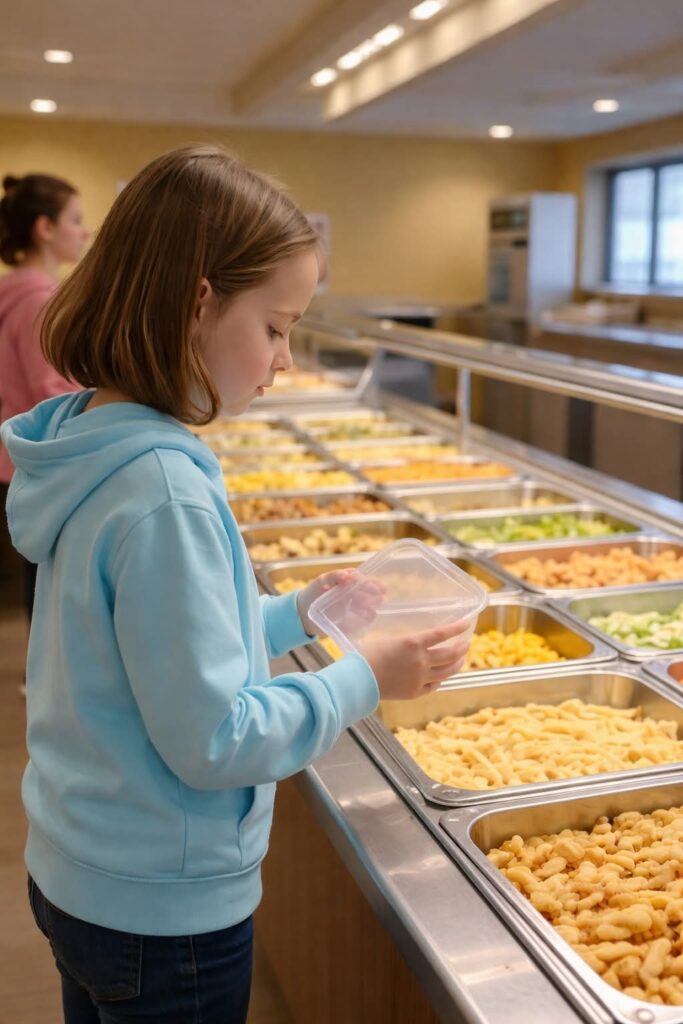
The room buzzed with its usual chaos: trays clattering, voices overlapping, the smell of warm pizza and sweet fruit cups. Amid all of it, one student moved differently. Mia Turner, nine years old, slight and soft-spoken, with brown hair that never stayed neatly tied, was slipping food into her backpack. Not randomly—carefully. A sandwich wrapped in paper. A fruit cup tucked into a side pocket. A slice of pizza folded inside a napkin.
She checked her surroundings before each move. She knew this wasn’t allowed.
Mr. Lewis walked over and knelt beside her table, keeping his tone calm and gentle.
“Mia,” he said quietly, “can you tell me why you’re putting food in your bag?”
She stiffened, her hand closing around an apple slice. For a moment, she stayed silent. Then, in a voice barely louder than a whisper, she said, “My mom works a lot… and sometimes money is tight.”
He didn’t challenge her. The explanation made sense. Still, something felt off. The way her eyes shifted—not toward home, but toward the cafeteria doors—suggested there was more she wasn’t saying.
That afternoon, after the last bell rang, Mr. Lewis made a difficult choice.
He followed her—carefully, from a distance.
Mia walked right past her own street, past the small duplex she shared with her mother. Instead of stopping, she kept going, her steps quick and determined. She didn’t want attention.
She passed quiet homes and empty playgrounds until she reached the outskirts of town. There, an abandoned house stood forgotten, its paint peeling, its windows cracked, the yard overrun with weeds.
Mia stopped.
She placed her backpack on the ground, took out the food, and arranged it neatly near the front door. Then she knocked twice—softly—and hurried to hide behind a broken wall nearby.
Mr. Lewis felt his chest tighten.
The door opened slowly. An elderly woman stepped outside, frail and unsteady, her gray hair loosely pulled back. Her hands shook as she picked up the food, her face filling with a gratitude that needed no words.
Mia stepped out from her hiding place. “Hi, Mrs. Callahan,” she said softly.
The woman smiled, eyes glistening. “You didn’t have to bring this again, dear.”
“I wanted to,” Mia replied. “You need it more.”
Mr. Lewis recognized the name. Mrs. Callahan—a widow he remembered from old community reports. Someone who had quietly disappeared from the system. He had assumed help had reached her.
It hadn’t.
Over the next few weeks, he watched closely. Mia repeated the routine almost every day. Some afternoons, she even brought scraps for stray animals she’d noticed nearby. And during that time, he learned the truth: Mia wasn’t hungry. Her mother, a nurse working long shifts, provided well for her.
This wasn’t necessity.
It was compassion.
But it was also dangerous. A child walking alone, hiding, navigating abandoned places—it wasn’t safe. Stopping her outright would leave Mrs. Callahan without support. Allowing it to continue unchanged wasn’t an option either.
So one afternoon, Mr. Lewis spoke to Mia at the school gate.
“I know what you’ve been doing,” he said gently. “And I understand why. What you’re doing is kind—but you shouldn’t have to do it by yourself.”
Her eyes widened. Fear crossed her face, then relief. “I just wanted to help,” she said.
“And you did,” he replied. “But now we’ll make sure it’s safe.”
Within days, he quietly reached out to local organizations. Food deliveries were arranged. Support services were contacted. Mrs. Callahan finally received the help she had been missing. At school, Mr. Lewis created a small, voluntary outreach effort—simple, respectful, and supervised.
When he told Mia, her smile said everything. Not pride in herself—but happiness that Mrs. Callahan wouldn’t struggle anymore.
Later that week, he invited her into his office and handed her a notebook filled with ideas: community food collections, kindness notes, small neighborhood projects.
“You already know how to lead,” he told her. “Now you won’t have to hide it.”
The idea spread quietly. Students joined. Families contributed. Visits were organized with care. The abandoned house didn’t change its walls—but it changed its meaning. It became a place of connection.
One afternoon, Mr. Lewis watched as Mia confidently guided a small group of students, helping distribute groceries. She glanced back at him and smiled—no fear this time. Only confidence.
That was when he understood something important.
Kindness doesn’t always ask for attention. Sometimes it fits inside a backpack. Sometimes it walks quietly down familiar streets. And sometimes, it comes from children who act simply because they can’t ignore what’s right.
By the end of the school year, Willow Creek Elementary had a permanent community outreach program—all sparked by one child’s quiet generosity.
Mia never stopped helping.
She just never had to do it in secret again.