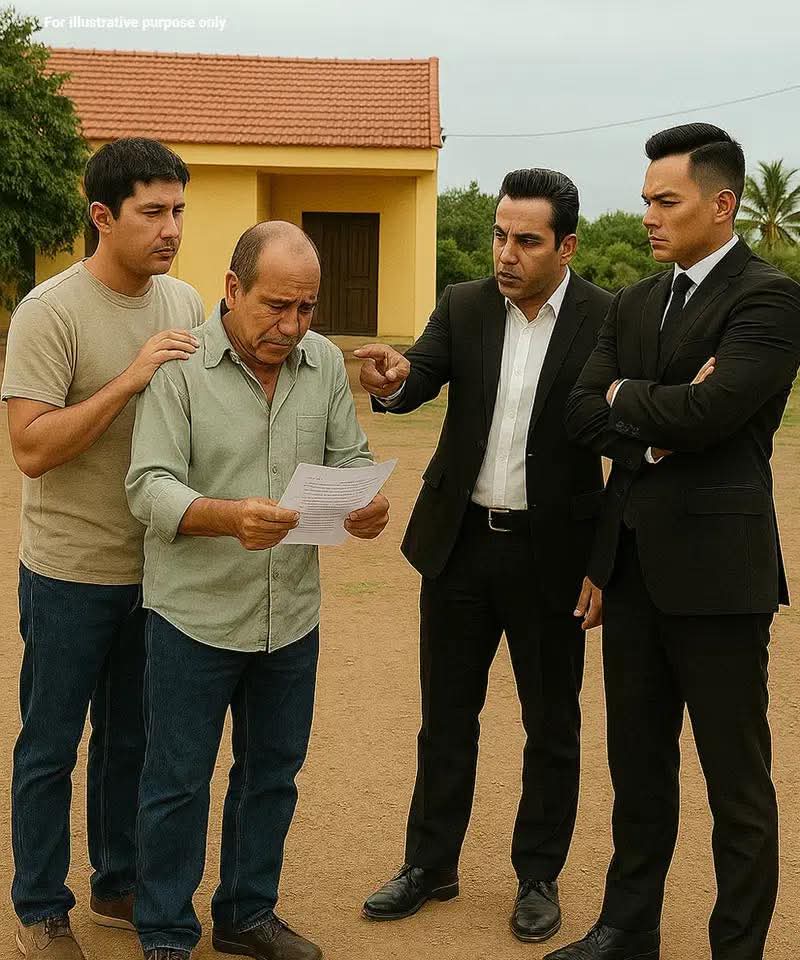
The day my father returned from the hospital, he arrived quietly and left a document on the table: a promissory note for 900,000$ , signed by him as the debtor.
My two older brothers stared at each other, looking for excuses.
The eldest said he was spending everything on his children’s college tuition; the second had just opened a hardware store and had no capital.
I—the youngest—had just gotten married and was still paying the mortgage. But seeing my father’s completely gray hair and hunched back, I couldn’t say no.
I took the promissory note, signed to assume the debt, and arranged for him to come live with me so I could take care of him.
A year passed, and life wasn’t easy.
I worked from dawn to dusk to pay off the debt; often the only meal was a plate of boiled nopales or beans.
My wife stopped buying clothes; she even sold the new motorcycle we had bought.
In return, I saw a rare but sincere smile on my father’s face, enjoying spending time with his grandchildren.
On the exact day that marked one year since I signed the promissory note, my father called me into his room and asked me to sit down.
He took a letter-sized piece of paper folded in half from a drawer and placed it carefully in front of me.
“Read it,” he said.
I opened it… and froze.
It wasn’t a promissory note. Nor was it a thank-you letter.
It was a will—in which he specified that the entire three-story house in the city center and a plot of land measuring over 300 square meters in the most commercial area of town would be left to me.
I looked up, and before I could say anything, my father smiled:
“All my life, I just wanted to know… who, in difficult times, would truly support me.”
At that moment, I was moved and my eyes were moist.
And just then, I heard footsteps at the door: it was my two older brothers.
Their gazes fell on the will in their hands, and their faces changed color.
They stood there, motionless.
Their expressions were no longer the indifference of a year ago, but a mixture of regret and bewilderment.
The eldest cleared his throat:
“Dad… why did you do that? We’re your children too.”
My father raised his head and, in a calm but firm voice, said:
“I know you all have your problems. But when I really needed you, only the youngest dared to take on this burden. This house and this land are the reward for that sacrifice.”
The second wanted to say something, but held back.
They both turned and left, their sandals dragging on the floor, as if they weighed tons.
I remained seated, my hands shaking as I held the will.
My father placed his hand on my shoulder and squeezed it tightly:
“You don’t have to pay that debt anymore. That money… was a test. I paid it off a long time ago.”
It was then that I understood that that year hadn’t just been a journey to pay off a loan, but a test of loyalty to see who truly valued blood and family.
The next day, news of the will spread throughout the family. Some said my father had been wise, others accused him of being unfair.
But I continued to care for him as always, because I knew that the most valuable inheritance I had received… wasn’t the house or the land, but the complete trust he had placed in me.
And that… no one could ever take that away from me.