The sound echoed across the quiet afternoon street.
Sharp. Final.
My face burned where her hand had landed, then went strangely numb.
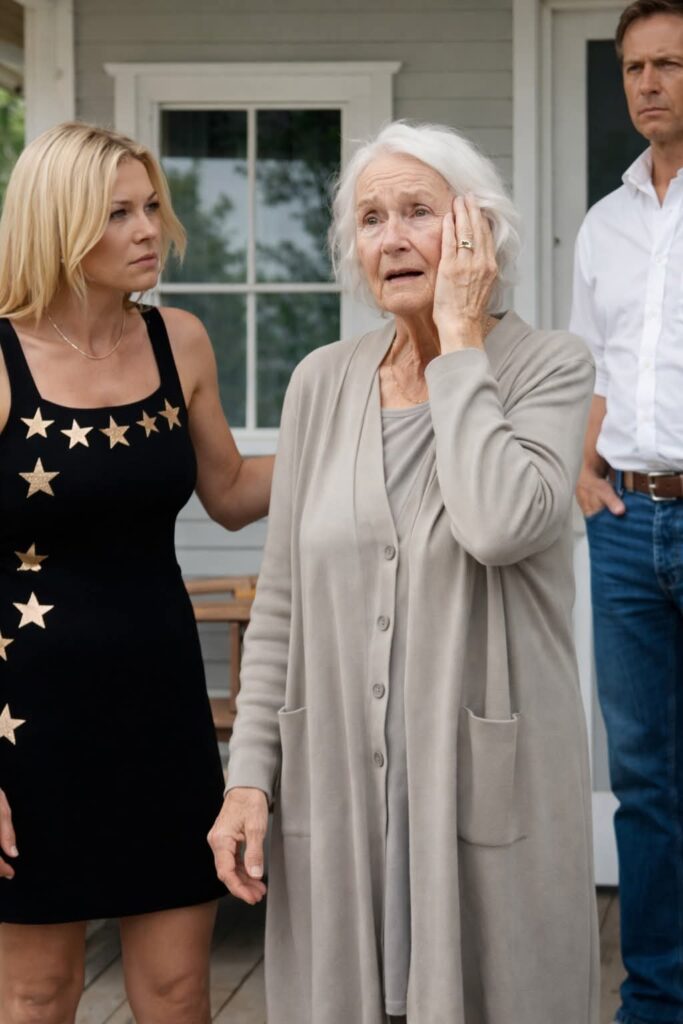
I stood frozen on my own porch, staring at my daughter-in-law, her jaw clenched, eyes blazing with anger.
Then I looked at my son.
David didn’t move. He didn’t speak. He didn’t step between us.
He simply watched.
That silence hurt more than the slap ever could.
It had all begun less than half an hour earlier.
I’d been washing dishes when I saw his SUV pull into my driveway, packed to the roof like a cross-country move.
David climbed out first. He looked exhausted, hollowed out, like someone who hadn’t slept in weeks.
Chloe followed, clicking up my walkway in heels, dragging two oversized suitcases as if she were checking into a luxury hotel.
We sat in my living room—the same room where David once tore open birthday presents and fell asleep during movie nights.
That was where he told me.
They had sold their house.
The one on Oak Avenue.
The one I helped them buy with forty thousand dollars taken from my retirement savings.
“Six hundred and twenty thousand,” David said quietly.
The number hovered in the air.
I tried to smile. Tried to be happy for them.
“So… where are you moving?” I asked.
Silence.
David stared at the carpet.
“Well,” he said finally, “we were hoping to stay here for a while.”
My stomach tightened.
I asked the question I already feared the answer to.
“What happened to the money?”
Chloe answered without hesitation, like she was reading a shopping list.
Designer jewelry. A California trip. Secret credit cards paid off.
Three hundred thousand dollars “invested” in a friend’s boutique.
Her sister’s kitchen renovation.
Her mother’s new car.
Every dollar gone.
And now they wanted my house.
The small, quiet home I’d spent thirty years paying off.
“You’re family,” David said. “You’re supposed to help.”
Something inside me went completely still.
“No.”
The word was soft, but it landed hard.
David looked stunned.
Chloe’s expression snapped from pleasant to furious.
“You’re really going to turn your back on your own son?” she spat.
She followed me outside, shouting insults for the neighbors to hear.
And then she hit me.
As I stood there, face throbbing, I finally understood the truth.
I wasn’t a mother to them anymore.
I was an asset. A backup plan. Something to drain.
I went inside, locked the door, and called the police.
Later, when the street was quiet again, I opened my old filing cabinet.
At the very back sat a thin, forgotten folder.
Inside was a signed promissory note.
Forty thousand dollars.
David’s signature at the bottom.
My next call wasn’t to my son.
It was to my lawyer.
Her name was Martha Gable.
She studied the document, then looked at me carefully.
“Are you certain?” she asked.
“Yes,” I said. “He needs to learn.”
She nodded once.
“Then we proceed.”
David called first, furious and incredulous.
“You’re suing me?”
“You signed a contract,” I replied.
“It was a gift!”
“A gift doesn’t come with demands,” I said quietly. “This was a loan.”
Discovery revealed everything.
Every receipt. Every transfer. Every indulgent expense.
Handbags worth more than cars.
Resort stays costing tens of thousands.
Money poured into accounts tied to Chloe’s family.
Then Martha found something worse.
The so-called investment was a shell company.
No business. No boutique.
The money had been moved again.
To Switzerland.
To an account under Chloe’s maiden name.
She hadn’t spent it.
She’d hidden it.
At the deposition, Chloe’s confidence collapsed the moment the bank statement slid across the table.
David’s face drained of color as realization hit him.
The case settled immediately.
My money was returned.
Chloe vanished.
David was left with nothing but regret.
Months passed.
Life grew quiet again.
Then, just before Christmas, my doorbell rang.
David stood there, thinner, tired—but real.
In his hands was a simple wreath he’d made himself.
“I’m sorry,” he said, voice breaking.
“For everything.”
He didn’t ask for help.
He offered accountability.
I opened the door.
“Come in,” I said. “It’s cold.”
Sometimes love isn’t about rescuing someone.
Sometimes it’s about stepping back—long enough for them to learn how to stand.
And sometimes, if you’re lucky, they come back not because they need shelter…
but because they finally understand what home truly is.