It started with a hard knock on the door and a stranger in a dark coat standing beside a black Mercedes on our broken driveway.
That morning, my house was already in full chaos. I was making school lunches while fighting with a clogged sink. Noa was crying because her stuffed bunny had vanished. Zelie was furious about her braid, which she said looked “wrong.” Strummer had turned the kitchen floor into a sticky racetrack using maple syrup and the dog.
So no — I was not prepared for anything out of the ordinary.
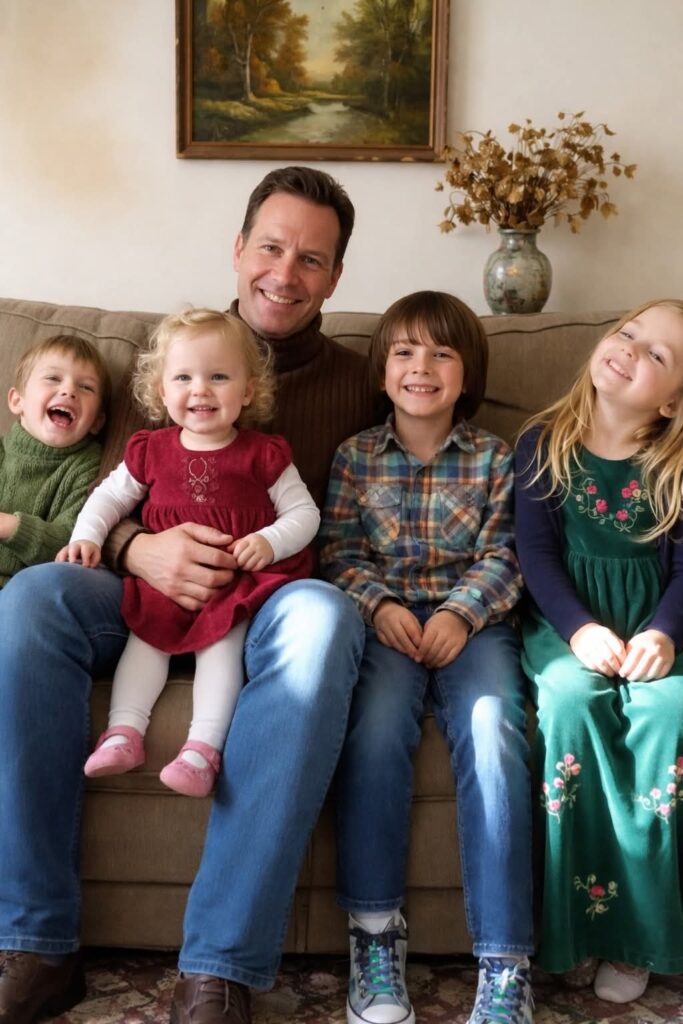
My name is Damon. I’m forty-two years old, a widower, a father of four, and tired in a way sleep doesn’t fix.
Two years ago, just after our youngest was born, my wife Ophelia started feeling weak. We blamed the exhaustion of newborn life. We were wrong. The diagnosis came fast, and the disease moved even faster. Eleven months later, she was gone.
Since then, it’s been just me and the kids. Qany is nine, Zelie is seven, Strummer is five, and Noa is two. I work long days at a warehouse and take any repair job I can find at night. Whatever keeps the lights on and food in the fridge.
That Thursday, after school and daycare, we stopped at the grocery store. Milk. Bread. Apples. Diapers. Only what we absolutely needed.
Strummer climbed into the bottom of the cart and narrated our shopping like a sports announcer. Zelie inspected bread as if she were a professional chef. Qany knocked over a display of granola bars and walked away pretending nothing happened. Noa sat in the child seat, singing the same line of “Row, Row, Row Your Boat” while showering herself in cracker crumbs.
I was doing mental math, hoping we’d stay under budget, when something caught my eye between two bruised apples.
A ring.
Gold. Heavy. A diamond that sparkled under the store lights like it wanted to be noticed.
I knew immediately it wasn’t costume jewelry.
For a brief moment, my mind raced. That money could fix the car. Repair the roof. Pay bills without panic. Maybe even give the kids a small break from worrying.
Then I looked at them — at Noa’s sticky smile, at Zelie proudly holding up an apple — and the thought faded away.
I slipped the ring into my pocket, planning to turn it in at the front desk. Before I could take a step, a trembling voice echoed down the aisle.
“Please… it has to be here…”
An elderly woman rushed toward us, her purse spilling receipts and tissues. Her hair was coming loose, her face pale with fear. She searched the shelves like someone about to lose the last piece of herself.
I stepped forward.
“Excuse me, ma’am. Are you looking for this?”
I opened my hand.
She froze. Then she let out a sound — like someone remembering how to breathe. She took the ring and pressed it against her chest.
“My husband gave me this on our fiftieth anniversary,” she whispered. “He passed away three years ago. This is all I have left of him.”
Her hands shook as she slid it back onto her finger. “I didn’t even feel it fall off.”
“I’m glad you found it,” I said softly. “I still wear my wife’s ring. I understand what it means.”
Her eyes moved to my children, who had gone unusually quiet. Her expression softened.
“They’re yours?”
“All four,” I replied.
“They’re beautiful,” she said. “You’ve raised them with love. It shows.”
She touched my arm gently. “What’s your name?”
“Damon.”
“I won’t forget it.”
Then she walked away.
I believed that was the end of it.
It wasn’t.
The next morning, between spilled cereal and sticky fingers, someone knocked again. This time, sharp and deliberate.
A tall man in a charcoal coat stood on the porch. The same black Mercedes waited behind him.
“Damon?” he asked.
I nodded.
“My name is Reed. You met my mother yesterday. She hasn’t stopped talking about you.”
I started to say that I hadn’t done anything special, but he continued.
“That ring was the last gift my father ever gave her. Losing it would have crushed her. She insisted I find you.”
He handed me an envelope.
“I can’t accept—” I began.
“She asked me to tell you that your wife would be proud of the man you are.”
The words hit me harder than I expected. I couldn’t speak.
Reed smiled, glanced at the chaos behind me — Noa toddling forward with purple-stained hands — and stepped back.
“Whatever you choose to do,” he said, “just know it mattered.”
Then he left.
I opened the envelope alone in the van after dropping the kids off.
Inside was a check for fifty thousand dollars.
And a handwritten note:
For your honesty. For reminding my mother that kindness still exists. For your four wonderful children. Use it wisely.
— Reed
I sat there for a long time, forehead resting against the steering wheel, letting the tears fall.
A week later, the car brakes worked again. The roof stopped leaking. The fridge was full. We ordered pizza on a Friday night, and Zelie announced it was the most elegant dinner she’d ever had.
We started a vacation jar. Qany drew mountains. Zelie drew the ocean. Strummer added dinosaurs and water slides. Noa scribbled purple joy all over it.
“Are we rich now?” Strummer asked.
“We’re safe,” I told him. “And that’s better.”
Sometimes life takes everything from you.
And sometimes, when you choose honesty without expecting anything back, life quietly gives you something in return.
One small decision in a grocery store changed everything.
And four children learned exactly what kind of man their father is.