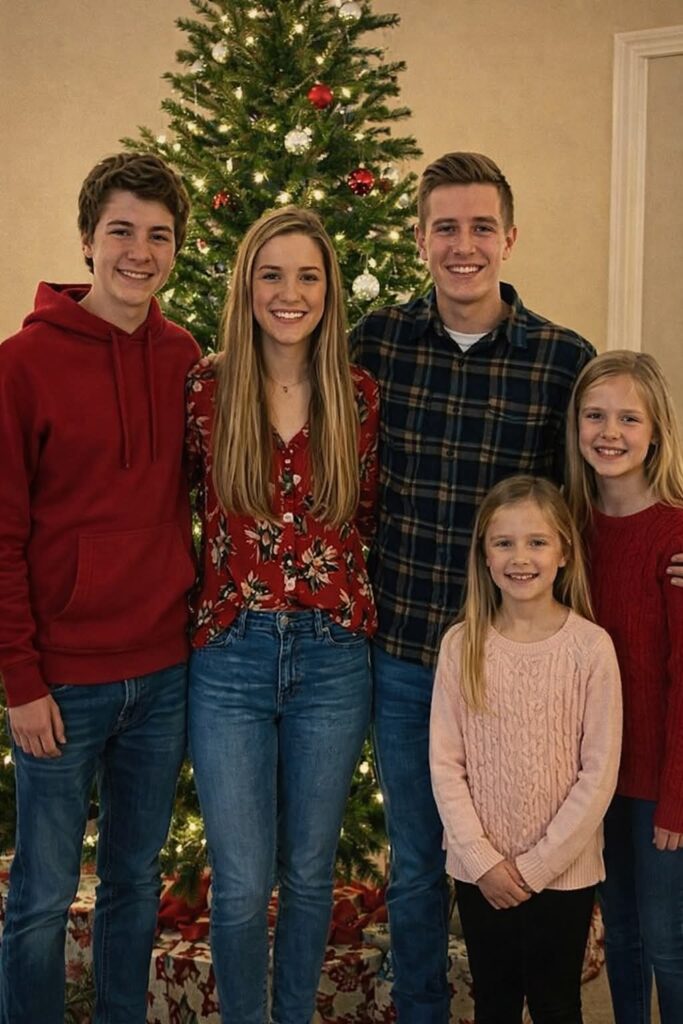
My name is Eliza, and I have a twin brother, Rowan.
Today, when people meet us, they see two composed adults who seem used to responsibility. What they do not see are the years held together by caffeine, fear, and stubborn determination. They do not see how close everything once came to falling apart.
We were twenty-four when life finally felt steady. But when it truly shattered, we were only eighteen.
We had just finished high school. We were comparing college costs, arguing about dorm fees, still believing adulthood came with a map.
There were five of us children altogether.
Rowan and I were the oldest. Then came Elliot, who was nine at the time. Mara was seven, sharp and watchful. And Lena was only five, small enough to believe that grown-ups could solve any problem.
They were noisy, chaotic, always hungry, always asking questions.
“Will you be home early tomorrow?”
“Is Mom okay?”
“Why is Dad acting strange?”
We did not have answers. We barely understood what was happening ourselves.
The diagnosis came on a Tuesday.
That morning our mother, Claire, burned the pancakes and laughed about being distracted. By the end of the week, we were in a dull, fluorescent office while a doctor spoke words that felt unreal.
Aggressive cancer. Immediate treatment. Limited options.
Rowan’s leg pressed against mine under the table. I stared at the floor. Our father, Graham, barely lifted his eyes from his phone.
Three days later, he gathered us in the living room.
He stayed standing, close to the door.
“I won’t drag this out,” he said.
Mara froze. Lena climbed into Mom’s lap. Elliot looked at the carpet.
“I’ve met someone,” Graham continued. “I have for a while.”
Rowan shot to his feet. “You’re kidding.”
“I can’t go through this,” our father said. “I’m not built to watch someone fade. I deserve to be happy.”
The silence that followed felt endless.
“You’re leaving?” Rowan asked.
He nodded. “You two are adults. You’ll manage.”
Our mother did not cry. She just held Lena tighter.
He packed a bag that night and walked out. No plan. No apology. No promise to help.
And after that, he vanished.
No calls. No support. Nothing.
Our mother weakened slowly. Rowan stayed home more with the kids. I spent nights at the hospital beside her bed.
One evening she reached for our hands.
“Promise me,” she whispered, “you won’t let them be separated.”
“We won’t,” Rowan said immediately.
“I promise,” I echoed.
She passed away two days later.
The courtroom felt too small for something so life-altering.
“Do you understand what this means?” the judge asked.
“Yes,” Rowan said.
“So do I,” I added.
The gavel came down, and just like that, we were not only grieving siblings anymore.
We were guardians.
The years that followed were a blur of exhaustion and determination.
We chose community college because it was affordable and nearby. We built schedules around school runs and pediatric appointments.
“If you take mornings, I’ll cover afternoons,” I would say.
“I’ll work early shifts,” Rowan replied.
We took any job we could find. I worked late nights serving tables. Rowan worked construction, warehouses, overnight stocking. Sometimes we crossed paths in the hallway at sunrise.
“You okay?” I’d ask.
“Always,” he’d say, even when he wasn’t.
There were moments when fear nearly swallowed us. When the refrigerator died, I stood in the kitchen fighting tears.
“We’ll figure it out,” Rowan said calmly.
And somehow, we always did.
The kids never saw the panic. They saw packed lunches, school recitals, and birthday cakes made from scratch.
One year, Lena hugged me after blowing out crooked candles.
“This is the best birthday ever,” she said.
I turned away so she would not see me cry.
Eventually, the storm eased. We graduated—late, tired, but proud. Rowan secured stable work. I did too. The house felt lighter. The laughter came easier.
We thought the hardest chapter was behind us.
Then one Saturday morning, someone knocked on the door.
I opened it and felt the air leave my lungs.
Graham stood there as if he had only been gone a week.
“You’ve done well,” he said, peering past me.
Rowan stepped beside me. “Why are you here?”
“We need to discuss the house,” he replied. “It was mine and your mother’s. It’s legally mine now. I’m moving back in.”
“For what reason?” I asked.
“My partner and I need it,” he said flatly. “You’ve had your time.”
Anger flared in my chest, but I forced myself to stay calm.
“Come back tomorrow,” I told him. “We’ll talk.”
That night, Rowan and I covered the kitchen table with paperwork.
Guardianship approvals. Legal filings. Property transfers.
And then we remembered something our mother had insisted on during her final months: speak to the lawyer.
The next day, when Graham returned confident and impatient, he was not greeted by uncertainty.
He was greeted by an attorney.
Documents were placed neatly in front of him.
The updated deed.
The revised will.
The legal protections our mother had quietly arranged.
“She made sure we were protected,” I said softly. “She knew we might need it.”
For the first time, he had nothing to say.
Legally, the house was not his.
Rowan opened the door and held it there.
“You need to leave,” he said.
This time, he did.
We later heard that his partner left once she understood there would be no house and no payout.
I did not feel triumph.
I felt relief.
Because what saved us was not revenge.
It was preparation.
And every time I unlock that front door, I remember the promise we made — and the promise we kept.