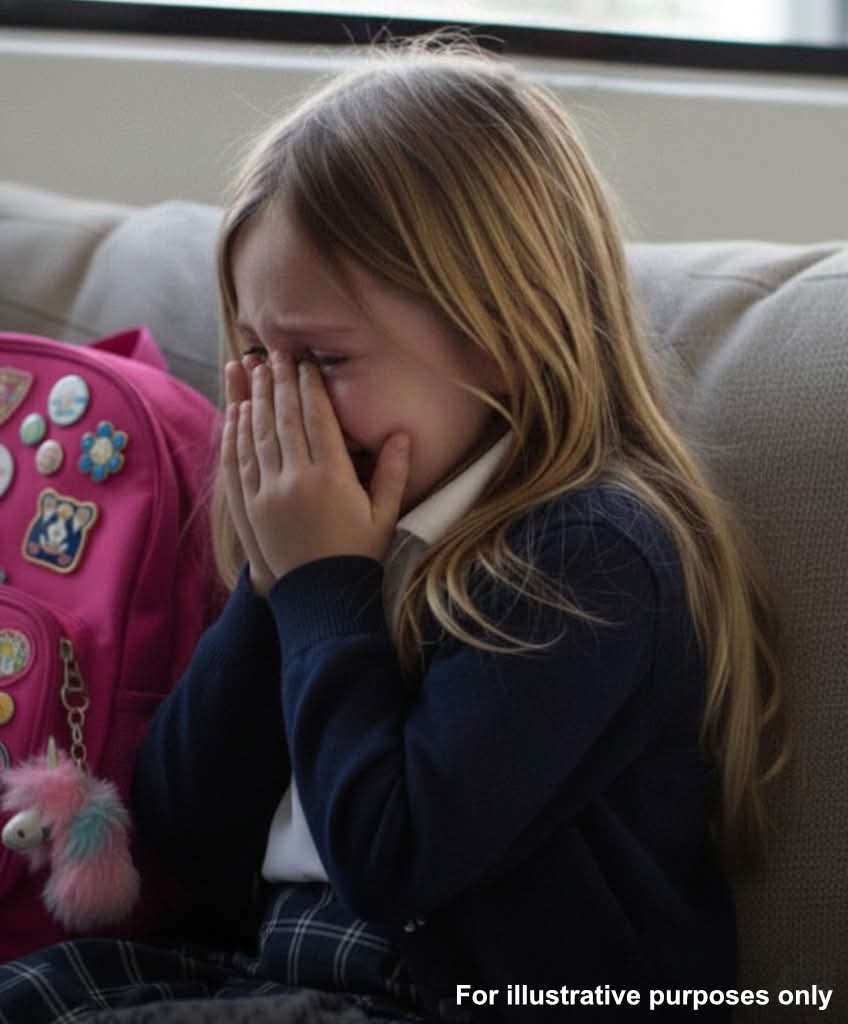
For weeks, my daughter came home from school with dim eyes and quiet tears, and I couldn’t understand why. So I followed my instincts, slipped a recorder into her backpack, and uncovered something no parent ever wants to hear.
I’m 36 years old. Until recently, I believed my life was steady and secure — a loving marriage, a peaceful neighborhood, a warm house with creaky wooden floors, and a little girl who brought light into every corner of it. Everything shifted the year my daughter started first grade.
My daughter, Liora, is six. She’s the kind of child who makes strangers smile without trying. She talks to everyone, invents her own songs, and dances through grocery store aisles like they’re stages built just for her. She is my whole world.
When school began in September, she marched through those doors like she was beginning a grand adventure. Her backpack looked oversized on her tiny shoulders. Her braids were uneven because she insisted on doing them herself. Every morning she’d shout, “Bye, Mommy!” before running off.
I used to sit in the car after drop-off, smiling to myself. Each afternoon she’d race back to me, bursting with stories — glue spills, class pets, who got to be line leader, and how Ms. Peterson said she had beautiful handwriting. I remember tearing up the first time she told me that.
She loved school. She made friends quickly. She couldn’t wait for show-and-tell. Everything seemed perfect.
Then, toward the end of October, something began to change.
It wasn’t dramatic. It was subtle. She started moving slower in the mornings. She sighed more. She fiddled with her socks as if they hurt her feet. She complained her shoes felt wrong. Some days she seemed on the verge of tears for no clear reason.
At first, I brushed it off. Children go through phases, I told myself. Maybe she was tired. Maybe it was just the darker autumn days.
But one morning I found her sitting on her bed in her pajamas, staring at her sneakers like they were something frightening.
“Sweetheart,” I said gently, kneeling in front of her, “we’re going to be late.”
Her lip trembled. “Mommy… I don’t want to go.”
My chest tightened. “Did something happen?”
She shook her head. “I just don’t like it anymore.”
Her answers were short. Her eyes avoided mine. And when I picked her up later that day, she walked slowly to the car instead of running. There was a dark streak across her sweater, like someone had dragged a marker over it. Her drawings were crumpled at the edges.
At dinner, she barely ate. When I asked again if someone had been unkind, she said no — but her voice cracked before she ran to her room.
That’s when I stopped dismissing my instincts.
The next morning, before zipping up her backpack, I slipped a small digital recorder into the front pocket. It was one I’d used years ago for community interviews. I tested it the night before. She didn’t notice a thing.
That afternoon, once she was distracted watching cartoons, I retrieved it and pressed play.
At first, there was nothing unusual — chairs scraping, papers rustling, children whispering. Normal classroom sounds. I almost felt foolish.
Then I heard a woman’s voice.
It was sharp. Irritated. Cold.
“Liora, stop talking and look at your paper.”
I froze. That didn’t sound like Ms. Peterson.
“I wasn’t talking,” Liora’s small voice replied nervously. “I was helping Ella—”
“Don’t argue with me,” the woman snapped. “You’re always making excuses. Just like your mother.”
My heart slammed against my ribs.
The recording continued.
“You think being sweet makes you special? It doesn’t. The rules apply to you too. And stop crying. Tears won’t save you.”
I could hear my daughter trying to hold back sobs.
Then came the part that made my blood run cold.
“You’re just like Mabel. Always pretending to be perfect.”
Mabel. My name.
This wasn’t random cruelty. This was personal.
I listened to it twice. Three times. Each word confirmed what I feared. Someone was targeting my child because of something that had nothing to do with her.
The next morning, I went straight to the principal’s office after drop-off. My hands were shaking, but my voice stayed steady.
“You need to hear this,” I said, placing the recorder on her desk.
As the audio played, the principal’s expression shifted from confusion to shock. When my name was spoken, her face drained of color.
She explained that Ms. Peterson had been out sick for weeks. A long-term substitute had taken over. Her name was Melissa.
When she turned the monitor toward me, I felt like the air had been pulled from my lungs.
Melissa and I had attended college together fifteen years ago. We were never friends. There had been tension during a group project. She once accused me of trying to win favor with a professor. I hadn’t thought about her in over a decade.
Apparently, she had never forgotten me.
Later that day, the school called me back in. Melissa was standing in the office when I arrived, arms crossed, eyes cold.
“So it’s you,” she said flatly.
I stared at her. “You’re bullying a six-year-old because of college?”
Her jaw tightened. “She’s just like you. Smiling. Acting innocent. People like that need to learn the world isn’t kind.”
“She’s a child,” I said quietly.
Before the confrontation could escalate, the principal intervened and asked her to leave. An internal investigation began immediately.
Within a week, Melissa was dismissed. The school issued apologies and arranged for counselors to speak with the students. A new substitute stepped in.
The difference in Liora was instant.
She started waking up early again. She picked out her favorite sparkly shirts. She ran to the car at pickup holding artwork and smiling the way she used to.
One afternoon while we baked cookies together, she looked up at me and said, “Mommy, I’m not scared of school anymore.”
I knelt beside her and brushed flour off her cheek. “I’m so glad.”
She hesitated. “Why didn’t she like me?”
I chose my words carefully. “Sometimes grown-ups carry hurt for a long time. But that has nothing to do with you.”
She nodded thoughtfully. “I still like being kind.”
And in that moment, I realized something important.
Not all harm comes from strangers. Sometimes it wears a professional smile and stands at the front of a classroom. Sometimes it hides behind old resentment.
But when we listen closely — really listen — we can protect the people who matter most.
And that is exactly what I will always do.