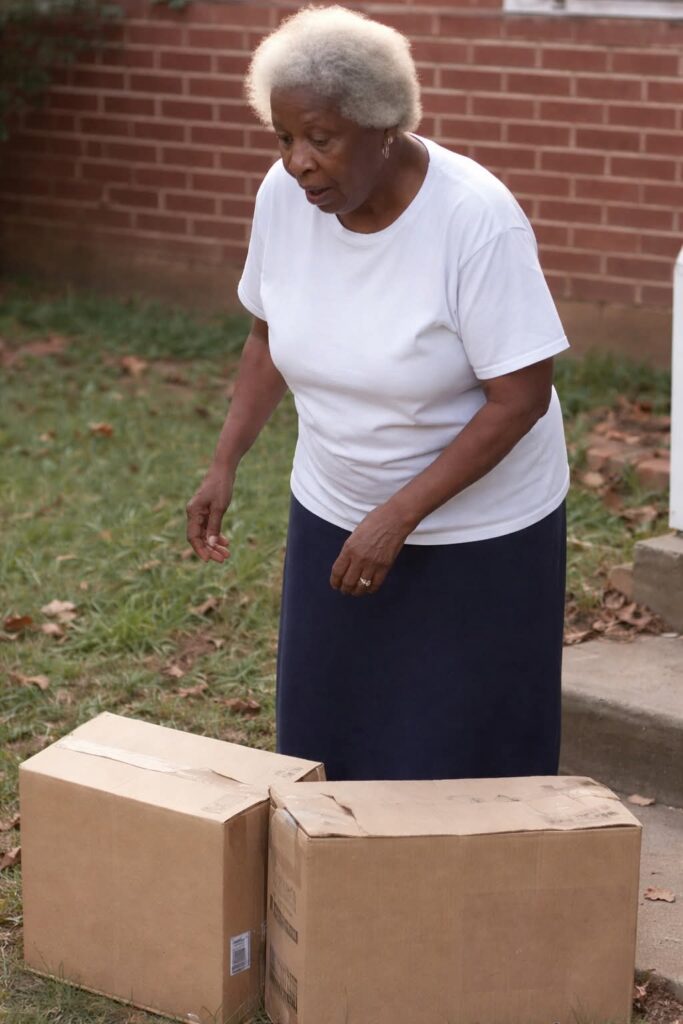
Margaux never expected to be seen.
For years, she had quietly left handmade clothes at the orphanage doorstep, always early in the morning, always without a note.
She believed her small acts of kindness would remain a secret forever.
Until the morning she opened her apartment door and found two large boxes resting on her welcome mat.
Her name was written neatly on top.
No return address.
No explanation.
At seventy-three, Margaux lived a life most people would never notice.
She occupied a tiny one-bedroom flat on the edge of town, surviving on a pension that seemed to shrink with every passing year.
Her husband, Matthieu, had passed away eight years earlier.
When he died, the warmth of companionship vanished with him, leaving behind a few old chairs, faded memories, and a silence that echoed through every room.
They had never had children.
There were no family visits, no phone calls asking how she was doing.
Her sister lived far away in Arizona, and their conversations were limited to brief holiday greetings.
Most days, Margaux spoke more to her television than to another person.
A stray cat sometimes sat on her windowsill, her only quiet companion.
She had worked as a seamstress for forty years.
Fixing hems, repairing coats, sewing late into the night to earn a little extra.
Even now, with stiff fingers and aching joints, her hands still remembered exactly what to do.
Knitting filled her evenings.
It kept loneliness from settling too deeply into her chest.
Money was always tight.
She clipped coupons, bought the cheapest brands, and walked everywhere to avoid bus fare.
Every small expense mattered.
One afternoon, she misjudged how much she could carry home from the grocery store.
Halfway down the street, the bags became too heavy, and her hands began to shake.
She stopped and rested them on the sidewalk, stretching her sore fingers.
“Do you need help?”
Margaux looked up to see a young woman in her thirties, with kind brown eyes and a gentle smile.
She wore simple clothes, but warmth radiated from her.
“I couldn’t ask you to,” Margaux said, even though her arms burned.
“You’re not asking,” the woman replied. “I’m offering.”
She lifted both bags easily.
“Where are you headed?”
“Two more blocks. Maple Street.”
They walked together, chatting about ordinary things.
When they reached Margaux’s apartment, the woman carried the bags straight into the kitchen.
“Thank you,” Margaux said softly.
“You’re very kind. Your parents must be proud.”
The woman hesitated.
“I never knew my parents. I grew up at St. Catherine’s Orphanage.”
Margaux’s heart tightened.
“I’m sorry. I didn’t mean—”
“It’s okay,” the woman said gently.
“It was a good place. I’m Manon.”
“Margaux,” she replied, suddenly wishing she wouldn’t leave.
“Would you like some tea?”
Manon glanced at her watch.
“I have work soon. Maybe another time.”
She smiled and stepped away.
“Take care.”
Afterward, Margaux sat at her table with a cup of tea.
That’s when she noticed the money tucked beneath the sugar bowl.
Three hundred dollars.
Enough for groceries.
Enough for medicine.
Enough to breathe a little easier.
She rushed to the window, but Manon was already gone.
For days, one thought stayed with her.
St. Catherine’s Orphanage.
She wanted to return the kindness, but she had no way to find Manon.
So Margaux looked at the money.
Then at her basket of leftover yarn.
Her hands still worked.
That night, she began knitting a small red sweater.
Two weeks later, it was finished.
Then another.
And another.
She placed the clothes in a sturdy bag and left them quietly on the orphanage steps.
No name.
No note.
She returned every month.
For six years.
Each stitch carried warmth, care, and hope.
Sometimes, she heard children laughing inside the building.
That sound made everything worth it.
Then, one cold October morning, the boxes appeared at her door.
Inside the first was a brand-new sewing machine.
Beneath it, an envelope filled with money and a letter of gratitude.
They knew.
The second box held drawings, cards, and handwritten thank-you notes from children who had worn her clothes.
A knock came at the door.
Manon stood there.
Behind her were dozens of children wearing sweaters Margaux recognized instantly.
“You kept us warm,” Manon said through tears.
“Now let us take care of you.”
For the first time in years, Margaux’s small apartment felt full.
Full of voices.
Full of love.
Kindness given in silence never disappears.
It always finds its way back home.