The sound of the slap wasn’t loud, but it went through the room like a fine knife, one of those that doesn’t make a fuss when it enters and yet still cuts everything inside.
My six-year-old daughter, Rose, put a hand to her cheek and looked at me with wide eyes of pure bewilderment, as if she still expected the world to correct the mistake.
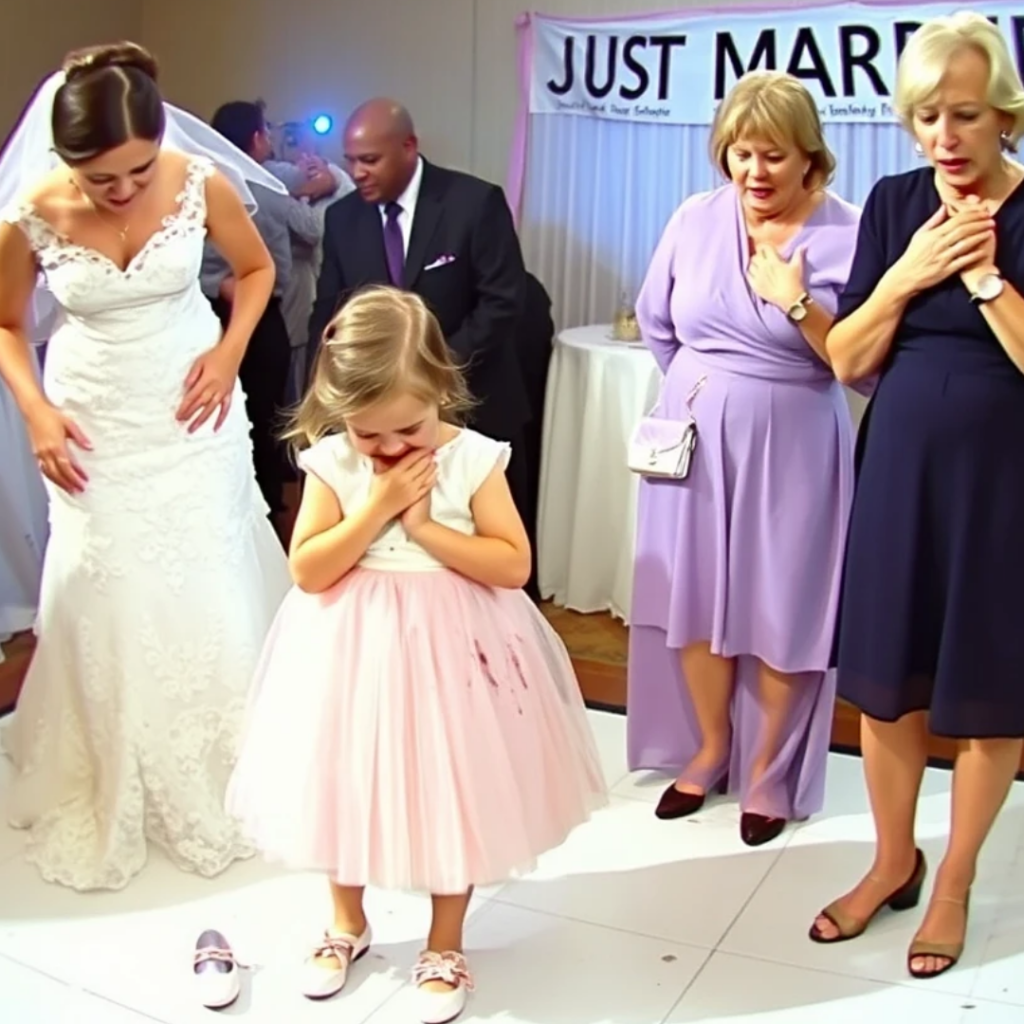
May be an image of child and wedding
It all happened in the main room of Beth’s house, my mother-in-law, during my niece Emily’s eighth birthday party, surrounded by lilac balloons, a three-tiered cake, and cardboard plates with princesses.
The reason had been a pale pink dress that Rose was wearing, a simple but beautiful dress that my sister Rachel gave her for her birthday and that she loved as if it were a crown.
Emily saw it, threw an instant tantrum and screamed that she wanted that dress because “it was prettier than hers,” and I thought, naively, that it would all just be an unpleasant childish scene.
But Beth didn’t bend down to explain to the girl the difference between wanting and possessing; instead, she turned to Rose and ordered her to take it off immediately and give it to her cousin.
Rose, still with that innocent frankness that children have when they haven’t yet learned to betray themselves to please adults, said that she didn’t want to take it away because it was hers and because Aunt Rachel had given it to her.
Beth slapped her before I could take a single step.
My body reacted late because the mind takes a second to accept that a grandmother can raise her hand against a child over a piece of clothing and someone else’s tantrum.
When I lunged towards Rose, my sister-in-law Heather intercepted me, pushed me by the arm, and then, with disgusting slowness, spat in my face.
“Teach your daughter some manners,” he said, wiping the corner of his mouth with satisfaction. “She’s already spoiled enough.”
I felt saliva trickle down my cheek as my whole world ignited with rage, shame, and a new kind of lucidity I had never known before.
Beth did not apologize.
He showed not a hint of remorse.
She smiled.
A small, clean, satisfied smile, as if she had just put in order something she had been allowing for too long.
And the worst was yet to come.
The worst part was seeing David, my husband, the man who should have crossed the room to stand in front of his daughter, nod slowly and say the phrase that broke me in two.
“You’re right,” he said. “Rose needs to learn not to defy the family over something trivial.”
Nonsense.
Our daughter’s red cheek.
The saliva on my face.
The demand to undress a six-year-old girl to satisfy the whim of another.
It all boils down to nonsense.
Rose began to cry for real then, not just from the physical pain, but from that particular kind of terror that children feel when they discover that the adults who should be protecting them have conspired to tell them that abuse is justified.
I hugged her tightly and felt her whole body tremble, small, hot, wet with tears, her breath ragged against my neck.
The party continued in a sort of tainted silence, with some guests looking down, others pretending not to have seen anything, and the children watching from the corners with that discomfort that only undisguised evil produces.
Emily was already distracted again, eating shoe polish with her fingers, while my daughter remained pressed against me as if the entire room had become a threat.
I didn’t scream.
I didn’t throw the cake.
I didn’t make the scene everyone expected, only to use it against me later.
I took Rose’s hand, went upstairs to get her jacket that was on a chair, and said we were going home.
Heather burst out laughing.
Beth muttered that I had always been theatrical.
And David, my husband, caught up with me in the lobby to tell me quietly that I was exaggerating and that I shouldn’t humiliate his family over “an old-school correction.”
Old school.
Another useful phrase to wrap cowardice in nostalgia.
I looked at him for a second and understood something I had resisted naming for years: my husband was not a weak man caught between two sides.
It was part of the system.
I drove home with Rose in the back seat, in silence, because every time I tried to speak, a mixture of crying and fury would rise up in me, which I didn’t want to turn into a scare for her.
Halfway there I looked up in the mirror and saw the red mark on her cheek, and I felt something inside me stop trying to fix the marriage and start organizing the outing.
As soon as we entered the apartment, I took her to the bathroom, washed her face with warm water, put a cold compress wrapped in a small towel on it, and sat on the edge of the tub while she continued to cry silently.
He asked me just one thing, and that question haunted me for weeks on end like a bell inside my chest.
“Did I do something wrong by wanting my dress?” she whispered.
I hugged her so tightly my arms almost hurt and I repeated to her, over and over again, that she hadn’t done anything wrong, that her body was hers, that her things were hers and that no adult had the right to hit her.
That night David did not return early.
She sent a message saying she would stay with her mother to “calm things down” and that I should take the opportunity to think things through, because family matters couldn’t be handled with hysteria.
I saved the message.
Then I also saved Heather’s audio where she was laughing with another woman and saying that finally someone had put Rose “in her place,” before she ended up being just as insolent as me.
I saved the photo of the blow.
I put the dress on the bed.
I put away my freshly washed face, still red from the spit.
But I didn’t just stay inside, holding onto the pain.
While Rose slept, with the warm compress next to her pillow, I went to David’s office and opened the bottom drawer where he kept “work” documents that he always asked me not to touch.
I was a legal assistant.
I had spent years looking at files, policies, powers of attorney, and forms.
I knew exactly what I was looking at when I had it in front of me.
First I found statements from a joint account I didn’t know about, in the name of David and Beth, from which periodic transfers had been made labeled as “school support” and “family contingencies”.
Nothing scandalous, until I checked the origin.
Part of the money came from the account where we were supposedly saving for Rose’s future.
I kept looking.
There was a life insurance policy that had been amended two months prior.
In the event of my death, the designated guardian for Rose was not Rachel, nor my best friend, nor even David with shared supervision.
It was Beth.
I had to sit down.
Not from tiredness.
Horrifying.
Because living with a cruel family is one thing.
It’s quite another thing to discover that they had already begun to legally write themselves into your daughter’s future life as if I were a temporary obstacle.
I also found emails between David and an agent where they talked about “protecting assets” and the advisability of moving certain assets to the name of a family company in case “the situation with Clara gets complicated”.
Clara.
I.
The mother of his daughter.
Treating me in emails as an administrative contingency.
That chilled my blood in a way that the spitting and the slap had not, because evil ceases to seem impulsive when it already exists on paper.
I took photos.
I sent myself copies.
I backed everything up to a cloud that David didn’t know about.
And then I started packing.
I didn’t take too many things.
That’s fair.
Clothes for Rose.
Your medications for mild asthma.
‘Happy Birthday Dad pending confirmation’
My work folder.
Passports.
Proceedings.
The cards.
The USB memory box.
The gray rabbit with one floppy ear that my daughter couldn’t sleep well without.
At 1:45 in the morning I loaded the car.
I didn’t feel like a coward.
I didn’t feel like a fugitive.
I felt exactly right.
As if the whole body knew that when a man chooses the family that beats his daughter, it’s no longer a matter of discussion.
It’s about getting out.
I took Rose to Rachel’s house.
My sister opened the door without asking a single question, saw the mark, saw my face, and understood everything with a speed that made me hate even more deeply those who had been saying for years that I was exaggerating.
“I should have insisted earlier,” he said, ushering us in.
I cried for the first time there, not out of weakness, but from the unbearable relief of being in front of someone who didn’t need to be convinced of the seriousness of the damage.
I told him everything.
The slap.
The spit.
David’s assent.
The policy.
The accounts.
The emails.
Rachel stood very still, her jaw clenched, her hands pressed on the kitchen table, and when I finished she said exactly the phrase I needed to hear so I wouldn’t go back to negotiating with monsters.
“This isn’t discipline,” he said. “This is violence. And what you found in his office was preparation.”
The next morning we went to the pediatrician.
Not just any urgent care clinic where the consultation gets lost in the volume, but a doctor with experience in documenting children’s injuries, recommended by a friend of Rachel’s who worked in a family court.
The mark was still there, more purple, sharper, more impossible to minimize.
The doctor examined Rose with almost painful delicacy and confirmed what I already knew: it had not been an accidental slap or a graze.
It was an intentional slap.
It was documented.
Photographed.
Described.
Signed.
She also recommended psychological evaluation because the girl exhibited hypervigilance, inappropriate guilt, and intense fear of adult conflict, all within twelve hours.
I nodded and signed while inside I felt a fierce mixture of rage and relief.
Relief, yes.
Because the damage was finally moving out of the territory of “my word against the family” and into the language that would hurt them the most: that of evidence.
David called at noon.
I put it on speakerphone so Rachel could hear.
He didn’t start by asking how Rose was.
He began by saying that everything had calmed down and that I should return before the situation “got out of hand”.
“The situation got out of hand when your mother slapped your daughter and your sister spat on me,” I replied.
Short silence.
Then came her statement, which finally confirmed for me that there was no marriage to save, only a structure of abuse to dismantle.
“You’re exaggerating,” he said. “It was just discipline.”
I hung up.
I saved the audio.
The messages came in waves afterward: Beth saying that if I continued to do “legal theater” I would regret it, Heather promising that she would end up dragging me back when my money ran out, and David insisting that I was leaving Rose without a family out of “pride”.
I saved everything.
That’s when my training as a paralegal stopped being just a job and became a perfectly honed weapon.
I knew exactly what constituted a pattern of harassment, intimidation, and manipulation.
He knew which messages to save, which dates to note, which screenshots to print, and what vocabulary not to use so as not to contaminate the file with anger when what he needed was forcefulness.
He wasn’t improvising an escape.
I was preparing a case.
Margaret Stein, the lawyer Rachel recommended to me, was a petite, gray-haired, impeccably dressed woman with eyes so calm they were frightening.
He reviewed everything in an hour without hardly interrupting me, then he looked up and smiled with a kind of professional satisfaction that only someone who recognizes a file with teeth has.
May be an image of child and wedding
“They don’t know who they’re messing with,” he said.
We plan quickly with her.
Emergency custody.
Protection order.
Evidence preservation notification.
Request for immediate psychological evaluation for Rose.
And a move that finally gave me back something resembling air: preventing Beth from having any contact with the girl while the investigation was open.
The child psychologist was even clearer than the pediatrician.
After two sessions with drawings, guided play and age-appropriate questions, she diagnosed trauma from domestic violence and continued exposure to bullying in a family context.
Not an isolated incident.
A pattern.
That pierced me in a new way.
Not because I didn’t suspect it.
Because it forced me to look back and admit how many small, poisonous scenes I normalized in order to survive in that family.
Beth’s comments about Rose’s body.
Heather’s teasing when the girl cried.
The times David said that his daughter was “too sensitive like her mother” just for wanting to choose her own clothes or toys.
Rose began to draw a picture repeated over and over: her and me behind a high fence, with four angry figures outside banging from the street.
The psychologist observed her silently the first time.
The second one said something to me that still takes my breath away if I remember it too clearly.
“Your daughter already imagined herself besieged before the slap,” he said. “Only now she’s finally put doors on her fear.”
While I was processing that, David tried another move.
He called my work.
Not directly to say goodbye, of course.
Men like him prefer to make a mess without leaving a trace.
He hinted that he was emotionally unstable, going through “a delicate episode,” and that it might not be prudent for him to handle sensitive documents for a few weeks.
I was lucky.
My boss, a divorced woman who had seen that script too many times in court, called me into her office, told me exactly what happened, and offered to register the attempt as workplace interference in the context of domestic violence.
I saved that too.
Margaret, meanwhile, had already hired a private investigator.
Not out of paranoia.
Because when a family operates with money, lawyers, and a sense of impunity, it’s not enough to simply defend yourself against what you see.
We need to shed light on what they have been hiding for years.
The researcher’s name was Tom Heller, and he had the bored face of men who have seen so much human garbage that they no longer need to hide their shock at anything.
It started with Beth.
It didn’t take him long to find things.
A former nanny who quit without notice after seeing Beth roughly shake a three-year-old boy “for not obeying.”
A neighbor who remembered Heather yelling at her nephews for hours and an informal complaint closed for lack of follow-up six years ago.
A former preschool teacher had noted concerns about “coercive interactions” between Beth and other children in the family, but never received support from the parents.
That was no longer a family with a bad temper.
It was an entire culture of abuse administered with smiles, money, and that cursed word they use to cover everything up: discipline.
Margaret didn’t seem surprised.
Just more interested.
Like a surgeon who discovers that the tumor is not only large, but old.
The following days were a low-intensity war.
Calls from unknown numbers.
Messages saying that Rose needed her father.
A bouquet of flowers without a card left in the car.
An envelope with photographs of David and the girl in happy moments, sent as if selective past could erase the hand that did not intervene.
I didn’t respond to anything.
I saved everything.
I made copies.
I didn’t sleep much.
I worked.
I took Rose to therapy.
I learned to distinguish fatigue from fear and fear from instinct.
Two weeks later came the first serious blow for them.
The court granted me emergency temporary custody, supervised visits for David, and an express prohibition of contact between Rose and Beth or Heather until further notice.
I didn’t cry when I read it.
I stayed still.
Then I rested my forehead on Rachel’s table and breathed as if the air had suddenly returned.
David exploded on the phone when he found out.
Not directly with me, because I wasn’t answering anymore.
He did so with Margaret in a call that she legally recorded as part of the threat follow-up.
He called her destructive, disproportionate, sick, and finally uttered the phrase that finished digging her legal grave.
“My mother only corrected her because Clara doesn’t know how to keep order,” she said.
There it was.
He wasn’t talking about a mistake.
He wasn’t talking about a momentary loss of control.
He kept justifying it.
With that single sentence, his entire strategy of being a reasonable father fell apart.
The family’s reputation began to crumble in circles they had always controlled: the church, the club, David’s office, the group of mothers at Emily’s private school, Heather’s daughter.
Not because of my screaming.
Because of the documents.
By the psychologist.
By the pediatrician.
By the old nannies.
Because of the pattern.
Beth tried to react by hiring her own investigator.
I thought they were looking for something about me, some stain, an ex-girlfriend from college, a financial crisis, a badly taken medication, anything to portray me as unstable.
What they found was something else.
Tom, our investigator, called me one night to tell me that the man hired by Beth had discreetly contacted him.
Not for sale.
To warn him that he was withdrawing from the assignment because he had discovered overly compromising movements within the family’s financial core and did not intend to touch that without cover.
Margaret smiled when we told her.
“Greedy people always think they can buy any eye,” he said. “They forget that some people prefer to sleep.”
A few days later we found out why the other investigator had run away.
In David and Beth’s joint account, in addition to Rose’s money, there were regular payments to a secondary policy and transfers related to a family trust created just six months earlier.
The trust contemplated “custody contingencies” and transition expenses for the permanent care of the minor in case of maternal incapacity.
Maternal incapacity.
The expression made me nauseous again.
Because it’s one thing to fantasize about controlling a granddaughter.
It’s quite another thing to invest money in the legal infrastructure to keep it when you still live with her mother and call her exaggerated for wanting limits.
Margaret didn’t say it out loud, but we both understood the same thing.
They weren’t necessarily planning to kill me.
It didn’t have to go that far for it to be monstrous.
It was enough that they had already thought enough about my possible departure from the path to organize themselves behind me.
That changed the case.
It was no longer just violence against a girl and paternal neglect.
There were indications of systematic preparation to remove me from my daughter’s legal life if something happened to me or if they managed to construct an image of instability around me.
The preliminary hearing was an elegant hell.
David arrived wearing a navy blue suit, with a serious expression and that way he had of feigning wisdom that for years confused many people, including me.
Beth couldn’t get in, but I saw her in the distance in the hallway with a Bible in her hand and the same look as always: not that of an accused woman, but that of a woman offended because the world dared to misinterpret her authority.
Rose was not present, of course.
I was with Rachel, making cookies and drawing pictures of houses with high fences, while I sat across from the man with whom I had shared a bed and now observed him as if he had been a neighbor I didn’t know well.
Sometimes the real divorce doesn’t begin with the paperwork.
The day begins when you no longer feel any intimacy, not even with your own memory.
David stated that I had taken the girl “in a state of overreaction,” that Beth had only tried to correct a selfish act, and that I was instrumentalizing a family incident to destroy ties.
Then Margaret started to produce evidence.
The photograph of Rose’s cheek.
The pediatrician’s report.
The diagnosis of trauma.
The audios.
The messages.
The phrase about discipline.
The policy.
The joint account.
The old statements of nannies and teachers.
I saw the exact moment when the judge stopped looking at him like a worried father and started looking at him like a man trying to normalize something that smelled like the system.
It was a minimal gesture, barely a tilt of the eyebrow.
But I had been living off the details for months.
I recognized him.
Beth screamed from the hallway when the court clerk came out with the extended restraining order.
They didn’t let her get close.
Heather called five times that afternoon.
I didn’t answer.
That same night, Rose fell asleep on Rachel’s couch with her head in my lap, breathing deeper than I had heard her breathe in months.
I touched her hair and thought that no legal victory was going to fully restore the part of her childhood that that family had tried to tame with fear.
Even so, the law was at least doing something I could no longer do on my own: putting up real doors.
Weeks later, when I was asked what really changed everything, many people expected me to say the slap.
But not.
The slap broke the surface.
What changed everything was David’s phrase.
“They are right.”
Because in those two words I understood that I wasn’t fighting with a cruel mother-in-law or a disgusting sister-in-law.
I was looking straight at a man who had decided what kind of violence his daughter deserved while she still had my last name on her lips.