I married the boy I grew up with in an orphanage, and the morning after our wedding, a stranger knocked on our door and told me there was something I didn’t know about my husband.
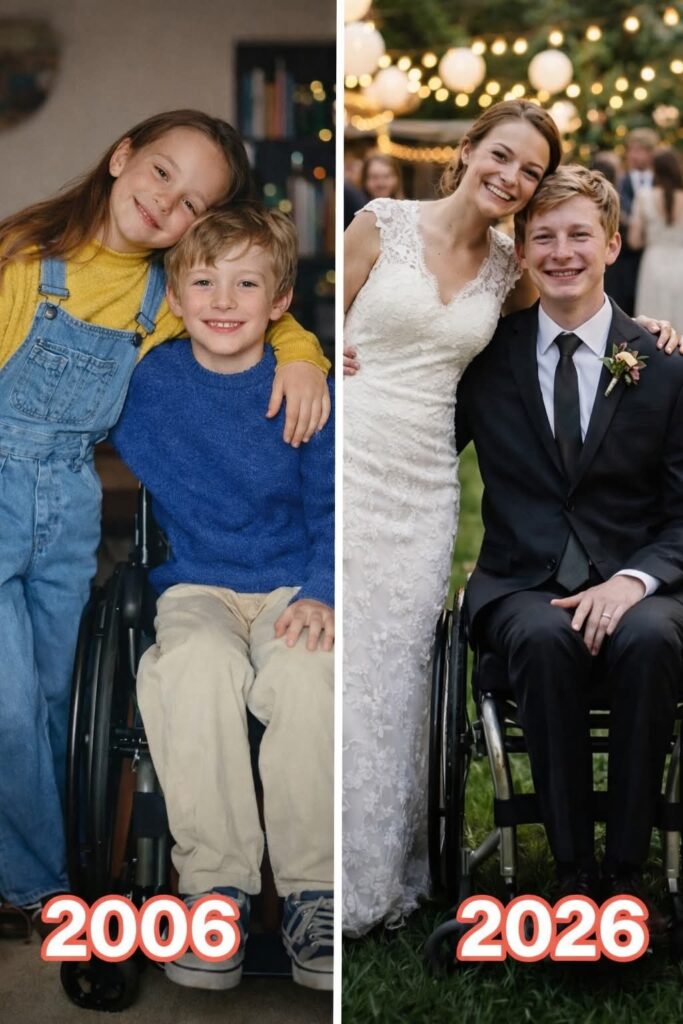
My name is Claire. I’m twenty-eight years old, and I was raised in foster care.
Before I turned eight, I had already moved through more homes than I can count. I figured out early that the safest way to survive was to expect nothing. Don’t get too close. Don’t believe anyone is staying.
When people say children are resilient, what they really mean is that children learn how to fold their clothes fast and stop asking questions no one wants to answer.
By the time I arrived at my final group home, I had made myself a promise: never get attached.
That promise lasted until I met Noah.
He was nine—quiet, sharp-eyed, with dark hair that refused to lie flat. He used a wheelchair, which made adults speak to him like he was fragile glass and made other kids hesitate, unsure how to include him.
They weren’t unkind. They just didn’t know what to do. They’d wave at him from across the room, then run off to games he couldn’t join. Staff talked about him as if he weren’t sitting right there.
One afternoon, I sat cross-legged beside him with a book and said, “If you’re guarding that window, at least let me share the view.”
He looked at me carefully. “You’re new,” he said.
“More like recycled,” I replied. “I’m Claire.”
“Noah.”
That was the beginning.
We grew up side by side. We saw the worst moods and the quiet disappointments. Every time a family toured the home, we already knew they weren’t there for us. Too old. Too complicated. Too much paperwork.
Whenever another kid left with a suitcase—or sometimes just a trash bag—we had a routine.
“If you get adopted,” he’d say, “I’m keeping your music player.”
“And if you get adopted,” I’d answer, “your favorite hoodie is mine.”
We joked, but the truth sat heavy between us. No one was lining up for the girl labeled “difficult placement.” No one was waiting for the boy in a wheelchair.
So we chose each other.
We aged out of the system within months of one another. At eighteen, we were handed documents to sign and told, “You’re adults now.”
No celebration. No speeches. Just plastic bags holding everything we owned.
Outside, Noah turned one wheel slowly and said, “Well, nobody can tell us where to go anymore.”
“Let’s try to keep it that way,” I answered.
We enrolled in community college and rented a tiny apartment above a laundromat. It smelled like detergent and overheated machines. The stairs were a nightmare, but the rent was low and no one asked questions.
It was the first place that felt like it belonged to us.
We filled it with secondhand furniture and curbside finds. Three plates. One good pan. A couch that squeaked every time you moved. It wasn’t impressive, but it was ours.
Somewhere between classes and late-night shifts, our friendship quietly changed.
There was no dramatic moment. Just the comfort of hearing his wheels in the hallway after a long day. The way he texted to make sure I got home safely. The way we’d fall asleep during movies, my head resting against him like it had always been meant to.
One evening I said, half-asleep, “We’re basically together already, right?”
He smiled at the screen. “I was hoping you’d say that.”
That was how it began.
We earned our diplomas one exhausting semester at a time. When they arrived, we stared at them like proof that we had rewritten something about our story.
“Look at us,” Noah said softly. “We made it.”
A year later, he proposed in our kitchen while I was stirring pasta sauce. He set a small ring box on the counter and said, “Do you want to keep building this life with me? Officially?”
I laughed and cried at the same time and said yes.
Our wedding was simple—folding chairs, a borrowed speaker, cupcakes instead of a traditional cake. Friends who had become our chosen family filled the room.
That night, we went home exhausted and happy, certain we had already received more than we ever expected from life.
The knock came the next morning.
It was steady and confident—the kind of knock that carries purpose.
Noah was still in bed when I pulled on a sweatshirt and opened the door.
A neatly dressed man stood in the hallway, calm and composed.
“Are you Claire?” he asked.
“Yes.”
“My name is Thomas. I’ve been searching for your husband.”
My stomach tightened. “Why?”
“There’s something he doesn’t know,” he replied, holding out a thick envelope.
Behind me, I heard the soft roll of wheels.
Noah joined me at the door, hair messy, wedding ring still shining.
Thomas looked at him carefully. “I’m here because of a man named Harold Peters.”
Noah frowned. “I don’t recognize that name.”
“You wouldn’t,” Thomas said gently. “But he remembered you.”
We invited him inside.
Thomas explained he was an attorney. Before Harold passed away, he had left detailed instructions regarding Noah.
Noah unfolded the letter and began to read.
Harold wrote about a day he slipped outside a grocery store. People passed by, avoiding eye contact. Then a boy in a wheelchair stopped. He gathered the scattered groceries, asked if he was hurt, and stayed until he was steady again.
No pity. No fuss. Just simple kindness.
Later, Harold realized he had seen that same boy before at a group home where he occasionally worked. Quiet. Observant. Overlooked.
Harold had no children of his own. No immediate family. But he had a home, savings, and a lifetime of belongings.
He wanted them to go to someone who understood what it meant to feel invisible—and who chose to care anyway.
“Please accept this as it was intended,” the letter concluded. “A thank you for seeing me.”
Thomas explained the rest: a trust fund, savings, and a single-story house already equipped with a ramp.
For the first time in our lives, the future didn’t feel like a tightrope.
Noah sat very still. “Usually when someone in a suit shows up, it means something’s been taken away.”
Thomas gave a small smile. “Not today.”
After he left, we sat in silence, trying to understand what had just happened.
We had built our lives assuming good things didn’t last. That security was temporary.
“I only helped him pick up groceries,” Noah said quietly.
“You treated him like he mattered,” I replied. “That’s bigger than you think.”
Weeks later, we visited the house. It smelled faintly of dust and old coffee. Framed photographs still lined the walls. The kitchen cabinets held neatly stacked dishes.
Noah rolled slowly through the living room, taking it all in.
“I don’t know how to live somewhere that feels permanent,” he admitted.
I squeezed his hand. “We’ll figure it out. We’ve figured out everything else.”
All our lives, no one had chosen us.
But one man did.
And sometimes, one choice is enough to change everything.