Taking my newborn to the emergency room in the middle of the night left me hollowed out, shaking, and barely holding myself together.
I never imagined that a stranger in the waiting room would make an already terrifying night worse — or that one doctor’s entrance would change everything.
My name is Lydia, and exhaustion has rewritten everything I thought I knew about myself.
Back in college, I used to brag about surviving on caffeine and reckless choices. Sleep was optional. Responsibility was a joke.
Now? My world runs on half-empty formula bottles, crumpled snack wrappers, and whatever the hospital vending machine offers at three in the morning.
That night, slumped in a plastic chair beneath flickering fluorescent lights, I finally understood how fragile I’d become.
Because it wasn’t about me anymore.
It was about her.
My daughter.
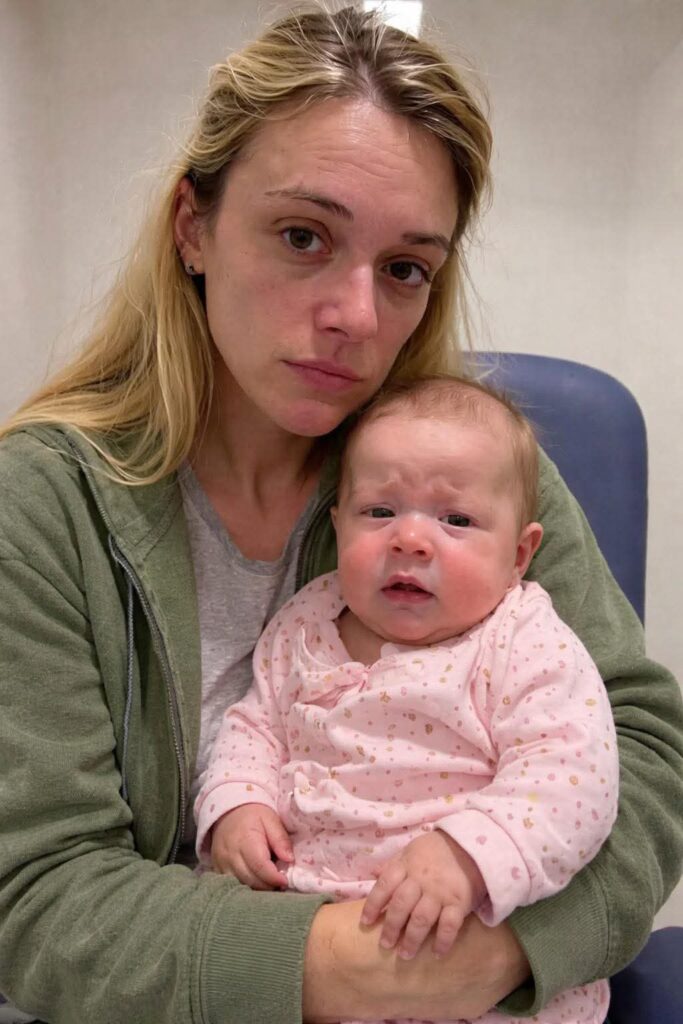
Sophia was only three weeks old — impossibly small, impossibly new, and already facing a world that felt far too harsh for someone so perfect.
I loved her with a depth that terrified me. A love so fierce it felt like fear wearing a different face.
And she was burning up in my arms.
She’d been crying since late afternoon. Not the normal fussing I was slowly learning to handle, but a relentless, desperate sound that scraped at my nerves and my heart alike.
By midnight, her skin felt too hot against my chest. I didn’t bother changing clothes. I didn’t think. I just grabbed my keys, slipped on shoes, and drove straight to the ER.
Now, her cries bounced off the sterile walls of the waiting room. Her tiny hands were clenched, her legs kicking weakly, her voice already hoarse from hours of distress.
“Shhh… Mommy’s here,” I whispered, rocking her gently, even as my own voice cracked from repeating the same promise over and over.
Nothing worked.
Every movement sent pain through my abdomen, the C-section incision reminding me that my body was still healing — or trying to. But I ignored it. Pain didn’t matter anymore.
Only Sophia did.
Three weeks earlier, I had become a mother.
And I had done it alone.
Her father disappeared the moment I told him I was pregnant. No argument. No apology. Just a quiet, “You’ll manage,” before walking out of my life forever.
My parents weren’t an option either. They’d died six years ago in a car accident, leaving me without advice, without backup, without anyone to call in moments like this.
So there I sat — twenty-nine years old, barely sleeping, barely healing, holding my feverish newborn and praying to a God I wasn’t sure I believed in anymore.
The waiting room was tense and quiet, broken only by Sophia’s cries.
Then a sharp voice sliced through the air.
“This is ridiculous. How long are we supposed to wait?”
I looked up to see a man across the room, early forties, perfectly groomed. His suit looked expensive. His watch caught the light every time he moved. He looked like inconvenience had personally offended him.
He snapped his fingers toward the front desk.
“Excuse me? Some of us actually have places to be.”
The nurse, Monica, didn’t even flinch. “We’re seeing patients based on urgency, sir. Please remain seated.”
He scoffed and waved his hand toward me.
“You can’t be serious. Her? She looks like she hasn’t slept in days. And that baby—honestly. Are we prioritizing this over people who actually contribute?”
My chest tightened. Around us, people shifted uncomfortably. No one spoke.
I pressed a kiss to Sophia’s damp forehead, my hands shaking — not from fear, but from exhaustion and disbelief.
The man wasn’t done.
“This is what happens when the system caters to charity cases. I pay taxes. I shouldn’t be stuck waiting behind people like her.”
I tried to stay silent. I really did. But when Sophia’s cries weakened into thin whimpers, something in me snapped.
“My baby is sick,” I said quietly, meeting his eyes. “She has a fever, and I’m terrified. But please — tell me more about how hard your night has been.”
He smirked. “Save the drama.”
Before anyone else could speak, the ER doors swung open.
A doctor entered, moving fast, eyes sharp despite clear exhaustion. His scrubs were rumpled, his expression focused.
“Who has the infant?” he asked.
I stood immediately. “She’s three weeks old. High fever.”
“Come with me.”
Relief hit me so hard my legs nearly buckled. I followed him, clutching Sophia close.
Behind us, the suited man exploded.
“What about me? I’ve been waiting forever! I have chest pain!”
The doctor turned slowly.
“And your name?”
“Victor Hale.”
The doctor studied him calmly. “You’re stable. You’re breathing fine. You’ve been loud and active for half an hour. This child, however, is three weeks old with a fever — which can become life-threatening very quickly.”
Victor flushed. “This is unacceptable!”
The doctor’s voice hardened. “What’s unacceptable is how you spoke to my staff and to this mother. She did exactly what she should’ve done.”
The room was silent.
Then someone clapped.
Then another.
Inside the exam room, everything slowed down.
The doctor — Dr. Bennett — examined Sophia carefully, explaining each step in a calm, reassuring voice.
After what felt like an eternity, he smiled.
“It’s a mild viral infection. No signs of anything serious. You caught it early. She’s going to be okay.”
I cried openly then, relief pouring out of me in shaking breaths.
Later, the nurse returned with two small bags.
“These are for you,” she said softly.
Inside were diapers, wipes, formula, and a tiny pink blanket with a handwritten note: You’re doing great.
For the first time since Sophia was born, I didn’t feel alone.
As I left the hospital, my daughter asleep against my chest, I passed Victor still sitting there, silent and ignored.
I smiled — not in triumph, but in quiet strength.
And I stepped into the night knowing I was stronger than I’d ever believed possible.